
Siding Contractors Serving Des Moines and Central Iowa
James Hardie fiber cement and Mastic vinyl, installed by a crew that has been detailing Iowa exteriors since 2001. Free siding inspections, top to bottom, with an honest recommendation on which material fits your house.
- BBB A Plus Accredited
- GAF Certified Plus
- Owens Corning Preferred
- InterNACHI Trained
- Local Since 2001
Siding Is a Weather Barrier That Happens To Be Visible
Siding is the largest single surface on your house and it has two jobs. One everybody thinks about: making the place look like somebody cares about it. The other is keeping water outside your walls, and that is the one that costs money when it goes wrong.
Almost every siding problem we get called about started as a water problem years earlier. Water gets behind a panel through a bad lap, missing flashing, or a nail driven through the face, then works on the sheathing until something gives. By the time you can see it, you are paying for carpentry too.
That is the part you cannot inspect from the driveway once the job is done. New siding should make your exterior look fresher and add real curb appeal and market value. It should also be dry behind the panels for decades. We will not trade the second for the first.
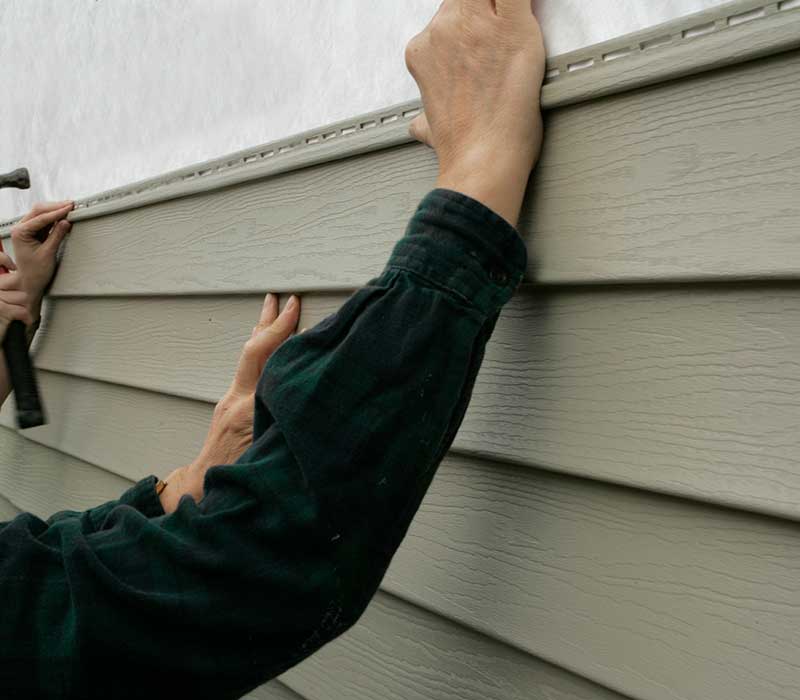
The Two Lines We Carry, Side by Side
This is the actual decision, and most siding pages dodge it. We carry James Hardie fiber cement and Mastic vinyl, install a lot of both, and do not have a favorite. Here is the honest comparison, in the terms that matter in Iowa.

James Hardie
Best when you are holding the house a long time, you want the painted-wood look, or hail has already found your exterior.
View the James Hardie catalog arrow_forward
Mastic
Best when budget is the governing constraint, you want to stop thinking about maintenance, or you are covering a lot of rental square footage.
View the Mastic catalog arrow_forwardSo which one do we actually recommend?
It depends on three things, and none of them is which product we would rather sell. How long you plan to own the house, what your budget genuinely is, and whether hail has already found your exterior once. A homeowner staying twenty years in a neighborhood that got worked over last storm season is a different conversation than an owner getting a house ready to list.
What we will not do is call vinyl a compromise when it is the right answer, or talk you into fiber cement because the ticket is bigger. And if your siding has years left and the money belongs in your roof, we will say that.
Inspection, Installation, Replacement, Repair
Four different jobs that get treated as one on most contractor sites. The right one for your house is usually not the most expensive one.
Free siding inspections
Same as our roof inspections and just as thorough. We walk all four elevations, check the bottom courses and everywhere a roof meets a wall, and press-test for soft spots. You get told what we found and what it means, including when the answer is that your siding is fine.
New installations
New construction or an addition. Pick the color and profile and we handle the rest: weather barrier, flashing, trim, corners, and the junctions with soffit, fascia, and gutter. On new work nothing is hidden yet, which makes the details easier to get right.
Full replacements
Like a roof, siding eventually loses both its looks and its strength. A replacement is also the one chance you get to see behind the walls, so we tear off rather than side over, inspect the sheathing, and tell you what we find before covering it back up.
Repairs
Rain, debris, and vermin all get into a house through siding damage, and a small hole becomes a big bill faster than people expect. We do repairs, quickly, and we will tell you honestly when a repair is throwing money at a wall that needs replacing.
What You Are Actually Looking For, and What It Usually Means
Take ten minutes and walk all four sides. Most of what matters is visible from the ground if you know what to look at.
Panels that give when you press them
Usually means the fasteners have let go, or the sheathing behind them has gone soft. The second is the reason to look now rather than in the spring.
Cracks, chips, or holes, especially on one elevation
Usually means hail or wind-driven debris. Damage concentrated on one side points straight at the direction the storm came from, and every crack is a path for water.
Waviness or buckling that shows up on hot days
Usually means vinyl nailed too tight with nowhere to expand. An installation problem, not a product problem, and it gets worse every summer.
Paint that will not stay on wood siding
Usually means moisture reaching the board from behind rather than from the weather. Repainting will fail again. The fix is on the other side of the board.
Dark staining or soft spots along the bottom courses
Usually means water running behind the siding, often from an overflowing gutter or a downspout dumping against the wall. Check your gutters before you blame the siding.
Interior stains under a window or where a roof meets a wall
Usually means flashing rather than siding. Those two spots account for a large share of the leaks we get called out for, and neither is fixed by replacing a panel.
What This Climate Does To a Wall
Siding has a harder life here than somewhere mild, and the reasons are worth understanding before you pick a material or compare two bids.
The temperature swing is the big one. Between a January morning and a July afternoon a wall here can swing well over a hundred degrees, and vinyl grows and shrinks measurably across every panel. That movement is normal, provided the siding was hung to allow for it. When it was not, you get the summer waviness and winter seam gaps people blame on cheap material.
Hail is the second. Central Iowa gets worked over regularly, and siding takes hail differently than a roof does. Damage lands on whichever elevation faced the storm, so you can have a clean south wall and a west wall full of cracks. Cold vinyl is more brittle than warm vinyl, which is why a spring or late-fall event can do more damage than a midsummer one.
Then there is water at the wall line. Overflowing gutters, downspouts dumping against the foundation, and ice damming under the eave all deliver moisture exactly where siding is least able to handle it. It is why we look at your gutters during a siding inspection, and why we would rather fix a drainage problem than sell you a wall that will rot again.
What we do about each of them
- thermostatHang vinyl to move. Nails centered in the slot, into framing, left loose enough that the panel slides. Roughly a thirty-second of an inch of play, which sounds like nothing and is the whole ballgame.
- straightenLeave the expansion gap at every trim piece and corner, about a quarter inch, and more than that when we are installing in cold weather because the panel is already contracted.
- shieldTalk honestly about impact where hail is a live concern, including whether heavier insulated vinyl or fiber cement is the better use of your money.
- water_damageCheck gutters, downspouts, and roof-to-wall flashing during the inspection, because a wall cannot outlast the water being delivered to it.
- wb_sunnyFlag the south and west elevations, which take the most sun and fade first, so color gets chosen with that in mind.
The Details That Decide the Job, All of Them Invisible Afterward
Two quotes for the same house can differ by thousands, and it is almost never the panels. It is this list. Every item here is buried behind the finished wall, which is exactly why it is worth asking about before you sign.
layersWeather barrier, lapped correctly
Housewrap only works if every upper piece laps over the lower one, the way shingles do. Lapped the other way it funnels water into the wall instead of out. Costs nothing extra to do right, and it is invisible ten minutes later.
roofingKickout flashing where a roof meets a wall
The one we care about most, and being a roofing company first is why. Where a roof edge runs into a wall, water needs flashing that kicks it into the gutter instead of behind the siding. Miss it and you get a slow, hidden rot column nobody finds for years. One of the most commonly skipped details in the trade.
windowWindow and door flashing
Every opening in your wall is a hole you are asking to stay dry. Head flashing, pan flashing, and sealing in the right sequence with the weather barrier is what makes that work. Caulk alone is not flashing, and caulk alone is what we find behind a lot of failed walls.
carpenterFastening into framing, with room to move
Nails go into studs, not just sheathing, centered in the slot, and on vinyl they stay loose enough for the panel to slide. Face-nailing through a vinyl panel is the fastest way to guarantee cracking and buckling, and it is still done constantly.
straightenA starter strip that is actually level
Every course above inherits whatever the first one did. A starter off by an eighth of an inch is a visibly crooked wall by the time you reach the soffit, and there is no fixing it at the top.
grid_viewTrim, corners, and J-channel
Where the siding stops is where it either sheds water or collects it. Corner posts, J-channel around openings, and the transition into soffit and fascia separate a job that looks tight at year ten from one that looks tired at year three.
delete_sweepTear off rather than side over
Faster and cheaper, and we will do it if you insist, but it hides the sheathing at the exact moment you have your only chance to look at it. We would rather pull it, see what is there, and tell you.
What Is Actually In Our Estimate
Siding quotes are hard to compare because contractors include different things and rarely say which. Here is our list, so you can hold anybody else's bid against it.
- task_altTear-off and disposal of the existing siding, including the dumpster and the hauling.
- task_altSheathing inspection once the wall is open, and a conversation before any rot repair happens, not a change order after.
- task_altNew weather barrier over the full wall, lapped correctly, not patched around the old.
- task_altFlashing at windows, doors, and every roof-to-wall intersection, as its own line rather than buried.
- task_altTrim, corner posts, and J-channel in the color you picked, quantified rather than estimated.
- task_altGutter removal and reinstall where they have to come off, plus a straight answer on whether they are worth putting back.
- task_altSoffit and fascia if in scope, priced separately so you decide rather than discover.
- task_altPermit handling where your city requires one. We will tell you either way before you sign.
- task_altDaily cleanup and a magnet sweep of the yard and drive, every day, not just at the end of the job.
Get your free estimate arrow_forward Call (515) 202-2173 call
Siding Does Not Work Alone
Where your siding meets your roof, soffit, and gutters is where walls actually fail. If we are already on the house, looking at the whole exterior at once is cheaper and smarter.
Siding Questions We Get in Central Iowa
How long should siding last in Iowa?
Longer than most people expect, if it was installed correctly. Quality vinyl and fiber cement both have long service lives, and what actually ends a siding job here is almost never the material wearing out. It is water that got behind it through a bad detail, or hail. That is why we spend more time on flashing and fastening than on which panel you pick.
Fiber cement or vinyl, if you had to pick for me?
Three things decide it: how long you plan to own the house, what your budget genuinely is, and whether hail has already found your exterior. Long hold, painted-wood look, or a neighborhood that keeps getting hit points to James Hardie fiber cement. Tight budget, large square footage, or wanting to stop thinking about maintenance points to Mastic vinyl. We install a lot of both.
Can you put new siding over the old siding?
It can be done and it is faster and cheaper, but we do not recommend it. A replacement is the only chance you will ever get to see the sheathing behind your walls. Siding over the top covers whatever is there, including rot you do not know about, and you are not getting a proper new weather barrier. We would rather tear off, look, and tell you.
Do you repair siding, or only replace it?
We do both, and we would rather sell you the repair when the repair is the right answer. Isolated damage on a sound wall is a repair. Widespread cracking, soft sheathing, or panels nailed wrong from the start is a replacement, because the repairs will not stop. A free inspection tells us which you are looking at.
How long does a siding job take?
It depends on the size of the house, the material, and how much trim work is involved, and any contractor who gives you a number before walking the house is guessing. We will give you a realistic window in writing before we start, and tell you promptly if anything behind the old siding changes it.
What happens if you find rot once the old siding is off?
We stop and show you before anything gets covered back up. You get photos, an explanation of how far it goes, and a price, and then you decide. What we will not do is quietly wrap it into the invoice at the end, or cover it and say nothing. On an older house it is common enough that we plan for the conversation.
Is siding damage covered by insurance?
Hail and wind damage to siding is often a covered loss, but that is between you and your carrier and coverage varies by policy. We inspect and document the damage with dated photographs and give you a written scope of work and an itemized estimate. That documentation is yours to submit. We can be on site during an adjuster's inspection to answer questions about our own scope. Under Iowa law we do not represent or negotiate with an insurance carrier on your behalf, and we would encourage you to be careful with any contractor who offers to.
Should we do the soffit, fascia, and gutters at the same time?
Usually yes, and not because it sells more work. Those pieces all meet each other, so one pass means one mobilization and every transition detailed together instead of working around somebody else's work. If your gutters have plenty of life left we will say so and leave them alone.
Let Us Take a Look Before You Take Action.
We will walk all four sides, tell you what we find, and give you a written estimate with the whole scope on it. Including, when it is the truth, that your siding has a few good years left yet.
Call (515) 202-2173 call Get a free siding inspection arrow_forward
Action Roofing & Construction
2422 Green Hills Drive, Norwalk, IA 50211admin@actionroofingandconstruction.comSee all service areas