
Roofing for Des Moines Metro Apartments, Associations and Portfolios
Garden-style apartments, townhome and condo associations, senior living, and small investment portfolios. Documented building by building, phased around your residents, and warranty-registered to the ownership entity that owns the asset.
- BBB A Plus Accredited
- GAF Certified Plus
- Owens Corning Preferred
- InterNACHI Trained
- Local Since 2001
You are not buying a roof. You are answering to somebody.
That is the real difference between multi-family work and a single house. Somebody upstairs has to sign off, whether that is an owner, a board, an asset manager, or a lender. Our job is to hand you what you need to get that yes, and then run the project so it does not come back on you. If you wear a lot of hats on a property, let us take a few of them off your shoulders.
Property Managers
You need a contractor who answers the phone, schedules around your residents, and does not create work for you. We coordinate directly with your site staff and keep you copied on everything.
HOA and Condo Boards
You are volunteers making a five- or six-figure decision in a one-hour meeting. We come with a condition report, photos by building, and a scope your whole board can read without a construction background.
Owners and Investors
The roof is a depreciating asset with a service life you can manage instead of react to. We will tell you what you can defer, what you cannot, and what deferring actually costs.
Developers and GCs
Multi-building schedules, inspection coordination, and a crew that shows up when the schedule says so. We work as a sub without needing to be managed.
Every Building Type Brings Its Own Roofing Problem
A garden-style apartment building is not a townhome row, and a townhome row is not a mixed-use box downtown. The failure points are different, so the scope should be too.
Garden-Style Apartments
Long unbroken eave and ridge runs mean wind gets a running start, and uplift almost always starts at a corner or a rake edge rather than in the field. Perimeter fastening and edge metal are where these roofs are won or lost.
Townhome Associations
One continuous roof over units that are individually owned. That makes party-wall detailing, firewall penetrations, and clear documentation of what the association covers versus what the unit owner covers a real part of the job.
Condominium Associations
Board-governed, reserve-funded, and usually reviewed by a lender at some point. These projects need documentation that will still make sense to somebody reading the file three years from now.
Duplex, Fourplex and Small Portfolios
Scattered-site owners get quoted like homeowners and scheduled like an afterthought. We price the portfolio as a portfolio and sequence the addresses so you get one mobilization instead of five.
Senior and Assisted Living
Residents who cannot easily relocate for a day, medical equipment that cannot lose power, and staff who need to know exactly what is happening and when. These get the tightest communication plan we run.
Mixed-Use and Live-Work
Retail or office below, residents above, and two completely different tolerances for noise and disruption. Work windows get built around whichever tenant has the tighter constraint.
Boards Vote on Documents, Not Conversations
A homeowner can decide in the driveway. You cannot. Somewhere between the inspection and the approval, this has to become paper that survives a board meeting, a budget review, or a lender question. So we build that paper as part of the job, not as a favor if you ask for it.
Assessment and Project File
Delivered as a single package. Yours to keep, forward, and put in the association record.Condition report, building by building
Not one summary for the property. Each building or address gets its own assessment, its own remaining-life estimate, and its own recommendation, so you can prioritize rather than treat the whole site as one line item.
Dated photo documentation, organized by building and elevation
Labeled and sorted, not a phone dump. When somebody asks six months from now what the north slope of Building C looked like before the work, the answer is in the file.
Written scope of work in plain language
What we are tearing off, what is going back on, which manufacturer system, and what is specifically excluded. Written so a board member who does not work in construction can read it and know what they are approving.
Line-item estimate
Broken out by building and by scope element, which is what makes it possible to phase, to compare bids honestly, and to see what changes when you add or remove a building.
Phasing calendar
Building sequence with target dates, so you can tell residents something specific and so the board can see how the spend lands across the fiscal year.
Resident and tenant notice templates
Written and ready to send under your letterhead, with dates, parking instructions, and what to expect. One of the most useful things we hand a manager, and one almost nobody offers.
Warranty registration in the ownership entity name
Registered to the association or the LLC that owns the asset, not to whoever happened to sign. This is the detail that decides whether the coverage is still there after a board turns over or the property changes hands.
Close-out documentation
Materials installed, quantities, dates, final photos, and warranty paperwork. The file a future board, a buyer, or a lender will ask for, assembled while the information is still fresh.
If you are collecting bids right now, ask the other contractors which of these eight you get. That question tends to settle it.
Plan for the Roof Before the Roof Plans for You
The most expensive roof is the one that fails on its own schedule instead of yours. Emergency replacement costs more, arrives at the worst point in the budget year, and usually comes with interior damage attached. Everything we do on the planning side is aimed at moving that decision back under your control.
That starts with an honest remaining-life number per building. Sometimes the answer is that you have four good years left and should spend the money on something else. We would rather tell you that and be here when the roof is actually due than sell you a project you did not need yet.
What we help you work out
- savingsReserve alignment. A per-building remaining-life estimate your reserve study or budget can actually use, rather than a single number for the whole property.
- calendar_monthPhasing across budget years. Two buildings this year, three next, sequenced worst-first so the money goes where the risk is.
- constructionRepair, restore or replace. A straight recommendation per building with what each option buys you in years, not a single quote for the most expensive path.
- checklistMaintenance packages per property. Scheduled inspection, minor repair, and documentation, tailored to the property rather than sold as a flat plan. On a multi-building site this is the cheapest money in the envelope.
- fact_checkBid comparison support. If you are holding three quotes that do not match, we will walk you through what is actually different between them, including ours.
Nobody Moves Out for a Roof
This is the part that generates the phone calls you have to answer. A roof replacement over occupied units is a communication project with roofing attached, and we treat it that way.
Notice before anything starts
Written notice per building, on your timeline and under your letterhead, with the dates and what residents need to do. Nobody wakes up to tear-off they did not know about.
Parking and staging planned first
Dumpster placement, material drops, and crew parking mapped with your site staff before mobilization, so we are not taking spaces residents need.
Vehicles and landscaping protected
Vehicles moved or covered, plantings and AC units protected, balconies and patios cleared and shielded under active work.
Work hours you set
Senior living, medical offices, and second-shift residents all have different windows. Tell us the constraint and we build the day around it.
Clean at the end of every shift
Debris cleared and a magnet sweep of lots, drives, and walkways daily. Not at the end of the project, at the end of each day.
Watertight every night
We only open what we can close. The building is dried in before the crew leaves regardless of where the work stopped, because the forecast does not care about our schedule.
One Building or Twelve, It Runs Differently
Most contractors run every job the same way and let you absorb the difference. A single-building replacement and a portfolio engagement are not the same project, so they do not get the same process.
Single Property
- task_altFree on-site assessment with full photo documentation, typically inside a week of your call.
- task_altWritten scope and line-item estimate, with options where options genuinely exist.
- task_altWe present to your board or owner directly if that helps, in person or on a call.
- task_altNotice goes out, staging is set with site staff, and the schedule is confirmed in writing.
- task_altInstallation, daily cleanup, final walk, and warranty registered to the ownership entity.
Portfolio or Multi-Building
- task_altEvery roof assessed and scored separately, then ranked worst-first so priorities are obvious.
- task_altA phasing plan built against your budget cycle, not against our calendar.
- task_altOne point of contact across every address. You are not re-explaining the property to a new crew lead.
- task_altConsistent documentation format across buildings, so year three reads like year one.
- task_altStanding maintenance and inspection between phases, so nothing you deferred gets forgotten.
What Actually Takes Roofs Down Around Here
We have been roofing Warren, Polk, and Dallas county properties since 2001. Multi-family roofs in this metro fail in a few predictable ways, and the ones that last are the ones detailed for it up front.
Wind uplift starts at the edges Not the field
Garden-style buildings give wind long, uninterrupted runs to work with, and the damage almost always begins at rake edges, corners, and eave lines. Perimeter fastening patterns and properly installed starter and edge metal are the difference between losing a corner and losing a slope. When you compare bids, compare the perimeter spec.
Hail damage on a complex hides longer More roof, fewer eyes
On a house somebody notices granules in the downspout. On a twelve-building property nobody is walking the north slope of every roof after a storm, so bruising sits undetected until it shows up as a stain on a ceiling. That is the argument for a documented post-storm inspection across the whole site rather than only the building that called in.
Ice damming follows the floor plan Attic and ventilation
Shaded north exposures, long low-slope runs, and interior units generating more heat than end units all conspire to melt and refreeze at the eave. On multi-family the fix usually lives in ventilation and insulation continuity across shared attic space, not in the shingle. We look at both.
Storm chasers target properties like yours Big contract, slow decision
A complex is a large contract with a decision-making body that takes weeks to move, which is exactly the profile out-of-state crews come looking for after a hail event. They will be gone before the first warranty claim. We are eleven minutes from downtown Des Moines, we have been at this address since 2001, and you can drive to us.
Two Warranties, and One Detail That Decides Whether They Hold
As a GAF Certified Plus contractor we can offer the System Plus and Silver Pledge limited warranties that most local roofers simply are not able to write. We are also an Owens Corning Preferred Contractor, and our team is trained through the InterNACHI inspection program, which is a large part of why our condition reports read the way they do.
Those tiers are set at specification, not after the fact. Which system goes on, which components come from the same manufacturer, and which underlayment and ventilation are included all determine the coverage you qualify for. So it is worth deciding what coverage the association wants before the system gets picked, and we will lay out what each path qualifies for.
The detail that catches people on multi-family: who the warranty is registered to. Register it to an individual and you have a problem the day that board member's term ends or the property sells. We register to the association or ownership entity and put the documentation in your close-out file.
Workmanship
Our own warranty on our installation, in writing, backed by a company that has been at the same Norwalk address since 2001.
Manufacturer
GAF System Plus and Silver Pledge tiers, plus Owens Corning system coverage, registered to the entity that owns the building.
Multi-Family Projects Around the Metro
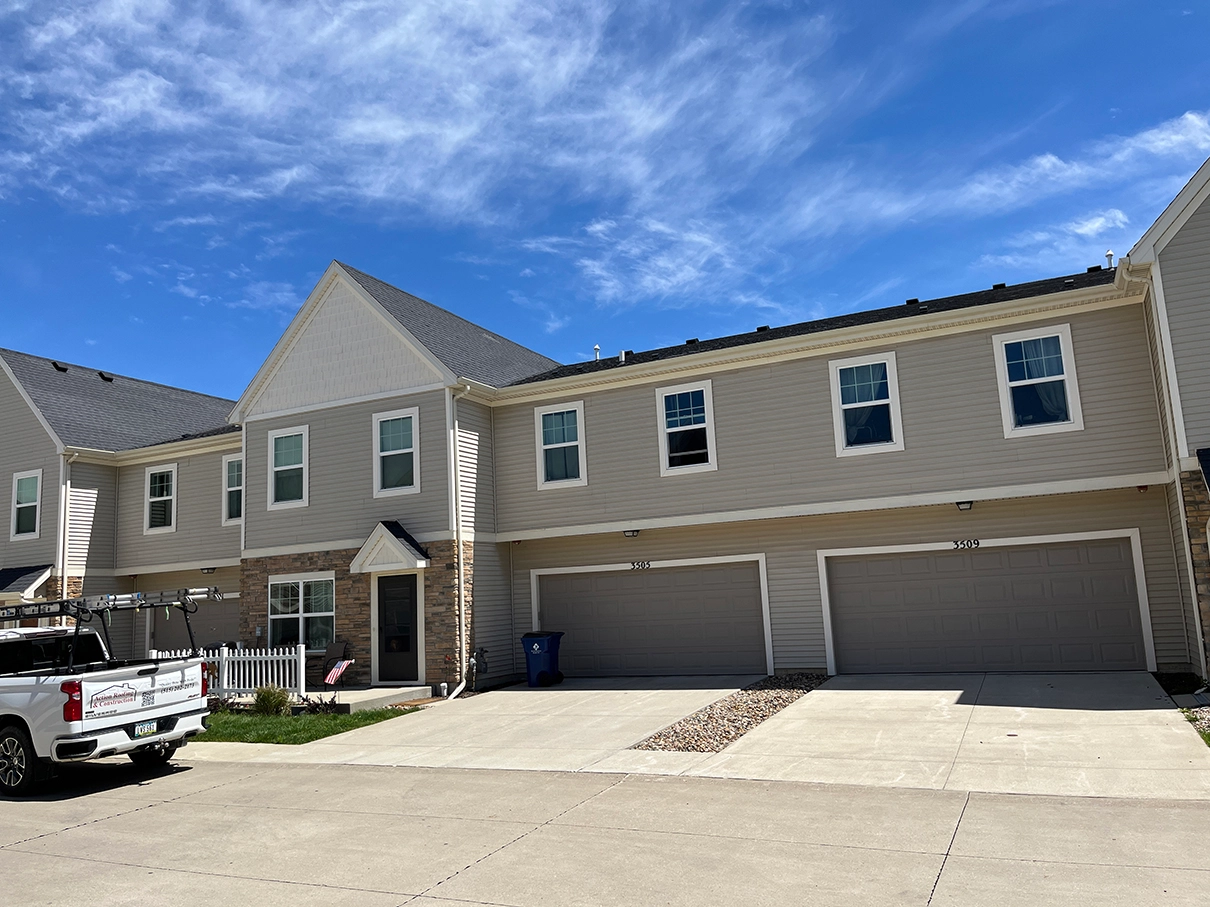
Apartment, townhome, and association roofs we have completed across the Des Moines metro, including tear-off and replacement, phased multi-building work, siding and soffit, and gutter systems. Action Roofing & Construction is A Plus rated with the Better Business Bureau and 4.9-star rated across our Google reviews.
Loading Gallery...
Questions Managers and Boards Ask Us
Do you work with property management companies across multiple properties?
Yes, and it is some of our favorite work. That means every roof assessed and scored separately, a phasing plan built around your budget cycle rather than ours, one point of contact across every address, and a consistent documentation format so the file you open in year three reads like the one from year one.
How do you handle residents during a roof replacement?
Written notice per building before anything starts, with dates and instructions, ready to send under your letterhead. Parking, dumpster placement, and material staging are mapped with your site staff before mobilization. Vehicles, plantings, and AC units get protected. Debris is cleared and the lot gets a magnet sweep at the end of every shift, and the building is dried in before the crew leaves each night.
Can a large project be phased across multiple budget years?
Yes, and on a multi-building property it is usually the right answer. We assess each building separately, rank them worst-first, and build a phasing calendar against your fiscal cycle. Because the estimate is broken out by building, you can see exactly what changes when a building moves from this year into next.
Who is the warranty registered to on an association or LLC-owned property?
The association or the ownership entity that owns the asset, not the individual who signed the contract. This matters more than people expect. Register coverage to a board member and you can have a real problem the day their term ends or the property changes hands. The registration documentation goes into your close-out file.
Do you provide condition reports we can use for reserve planning?
Yes. You get a condition report per building with a remaining-life estimate, dated photos organized by building and elevation, and a straight recommendation of repair, restore, or replace with what each option buys you in years. It is written to be usable by a reserve study or a budget committee, not just by a roofer.
How do you price a multi-building project?
Line-item, broken out by building and by scope element. That is what makes it possible to phase the work, to compare our bid honestly against another contractor's, and to see exactly what the number does when a building is added or removed. We will also walk you through what is different between competing quotes if you are holding several that do not match.
Can you work around occupied units and business hours?
Yes. Senior living, medical and professional offices, retail below residential, and second-shift residents all have different constraints, and they are not the same constraint. Tell us which one governs your property and we build the work day around it.
What happens if we find storm damage during the assessment?
We inspect and document the condition of every roof on the property with dated photographs, and we give you a written scope of work and an itemized estimate. That documentation is yours, and you submit it to your carrier. We can be on site during an adjuster's inspection to walk the roof and answer questions about our own scope. Under Iowa law we do not represent or negotiate with an insurance carrier on an owner's behalf, and we would encourage you to be careful with any contractor who offers to.
Plan for the Future. Put Your Trust in ACTION.
Send us the property and we will walk every roof on it, document what we find, and put a written scope and a real number in your hands. No obligation, and no pressure to do all of it at once.
Call (515) 202-2173 call Request a property assessment arrow_forward
Action Roofing & Construction 2422 Green Hills Drive, Norwalk, IA 50211 admin@actionroofingandconstruction.com See all service areas